
How Long is a Patent Good for?
Quite fair to wonder how long is a patent good for? Premature loss of IP rights stems from miscalculated patent duration. Not a risk anyone wants to suffer. We will offer you some clarity here on the validity terms of patents to help you protect your inventions.
How Long Do Patents Last?
A patent’s type decides its life. Nonprovisional applications and utility patents last 20 years after the filing date. Design patents are good for 15 years. The purpose of provisional patents is to secure a filing date only. Plant and international patents go for 20 years. Continuing patent applications serve the 20-year term.
Patent expiration date can be adjusted based on some factors. Processing delays or regulatory reviews are common ones. Our task as patent attorneys is to educate you on timing guidelines. We help you learn how patent protection is different across various categories.
Protect your invention with expert precision
Protect your invention with precision and maximize every year of patent coverage. Consult John Rhizvi today for strategic IP protection.
Patent Terms Dependent on the Patent Type
Various patent types have various IP rights. They have different lengths of time.
How long does a Utility Patent last?
Utility patents are fine for 20 years (just make sure that they are filed after June 8, 1995). You can expect extensions and adjustments to this term of 20 years. Utility patents are the patents that are usually issued.
This patent protects machines, processes, novel ideas, and useful compositions of matter. The purpose of a utility patent is to protect how something works and is used.
How Long is a Design Patent Good For?
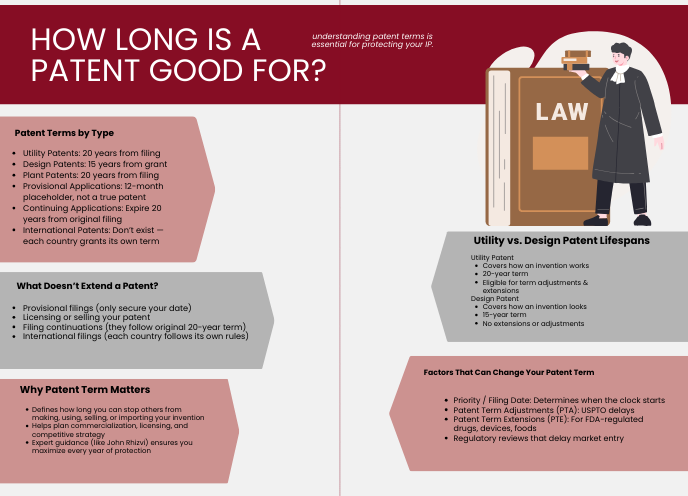
Design patents can survive 15 years from the issuance date of your application. This patent is meant for design inventions and it does not welcome extensions or adjustments.
Design patents protect the appearance and shape of your invention. It shields the way something looks. A single invention can be applied for both utility and design patents if it has both design features and useful applications.
How much does a Provisional Patent Survive?
A provisional patent application is not for invention protection or life extension of a patent. It rather secures a filing date. A provisional patent application preserves your date with the USPTO and relieves you of the process of filing a formal application.
How Long is a Continuing Application Relevant?
A patent granted on a continuing application will expire 20 years from the filing date. This rule is there to avoid any monopoly by the inventors. The same terms are for any adjustments to its original form since it is based on the associated IP and patent application.
How Long is the Life of a Plant Patent?
Plant patents are designed to protect distinct varieties of plants. These plans have been discovered or invented. This patent allows the holder solid rights to prevent everyone else from using, selling, or asexually producing the given plant.
How Much is the Lifeline of an International Patent?
International patents do not exist! This question exposes a misunderstanding. We can rather answer about the Patent Cooperation Treaty. Every country’s patent office implements terms. Design patents last 15 years and utility patents last 20 years.
Factors That Affect How Long Your Patent Can Last
Patent Term Highlights: How Long Is a Patent Good For?
Specific requirements and situations from the USPTO can impact the duration of patents.
1. Application Dates
The filing date affects how long patents can survive. It is called your “priority date.” Make sure to submit on a date that fits your patent the most.
2. Term Adjustments
The USPTO implements changes to account for unpredictable delays when your patent is pending. The USPTO can take a while to review changes you make or to review your initial application.
3. Term Extension
A term extension extends the term duration. It is mostly applicable to food items and medical devices with pharmaceuticals that the Food and Drug Administration regulates.
Importance of a Patent Term
Why is it crucial to understand the terms of your patent? It tells you how long a patent owner is allowed to keep the patent rights and intellectual property. The 35 U.S.C. § 154 states:
Every patent shall contain a short title of the invention and a grant to the patentee, his heirs or assigns, of the right to exclude others from making, using, offering for sale, or selling the invention throughout the United States or importing the invention into the United States, and, if the invention is a process, of the right to exclude others from using, offering for sale or selling throughout the United States, or importing into the United States, products made by that process, referring to the specification for the particulars thereof.
Conclusion
How long is a patent good for? The answer varies as there are various patent types. Plant and utility patents are good for the next 20 years. Design patents last only 15 years. Provisional filings just reserve your priority date. Misjudgment of these timelines puts your invention at risk. Working with an experienced patent attorney like John Rhizvi increases the chances of your success with the patent.
FAQ
Expert Tip
“One of the most common mistakes inventors make is misunderstanding when the 20-year patent clock actually starts. For utility and plant patents, the term begins from the earliest nonprovisional filing date, not the approval date. Filing too early without a fully developed invention or delaying conversion from a provisional application can significantly reduce effective patent life. Strategic timing is critical to maximizing the full patent term.”

Andrew Hirshfeld
Former Acting Director, U.S. Patent and Trademark Office (USPTO) & U.S. Patent Attorney