
How Long Does a Patent Take?
Everyone who wants to protect their intellectual property soon wants to know how long does a patent take. Their impatience is understandable. The United States Patent and Trademark Office (USPTO) take a long while to review and approve a patent application. The process is governed by 35 U.S.C. § 111.
Expected Time For a Patent Approval
Expected Patent Approval Timeline
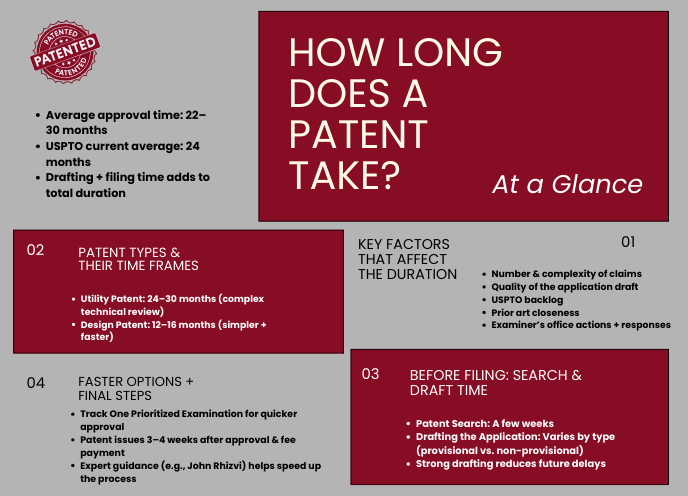
The average time consumption goes from 22 to 30 months after you file your patent application. You can expect 24 months as the current average time. Your patent type and the complexity level of your patent range the time frame.
Preparing and drafting your patent application also consumes a lot of time. You will have to factor this in, too.
Time Frame with a Patent Type
How long does it take to obtain a patent? It is not easy to answer that question unless you decide on a patent type first. There are two main patent types:
1. Utility
2. Design
A utility patent is for the performance of something: the way something works and is used. A utility patent protects your idea by prohibiting others from selling, making, and using it without your authorization.
A design patent protects the design of your idea. It shields the way your idea looks. This includes the configuration and shape of something as well as the applied surface ornamentation. A design patent protects both the ornamentation and shape.
Time delays are eligible under 35 U.S.C. § 154(b) for Patent Term Adjustments. It guarantees that patent owners are not responsible for the time delays from UPSTO and therefore must be compensated for the lost time.
Consult John Rhizvi for a faster process!
File your patent application ASAP and turn your invention into a patented success story today!
Factors Affecting the Duration of a Patent Application Process
Utility patents take longer to obtain than a design patent. One of the main reasons is that utility patent applications are far harder to prepare and will take a lot of time to be filed.
The second main cause is that the examiners at the Patent Office lack the application backlog to review design patents.
A third possibility is that the examiner might have an issue with the patent application. Design patent application issues are easier to resolve. Even a simple response can earn you approval of the design patent application.
Patent Search Time Frame
There are crucial steps to be aware of before you file a patent application. These steps can speed up the process.
The very first step is to conduct a patent search. Look through the various patent databases of the United States Patent and Trademark Office. Patent search can take a few weeks (it depends on the energy and time you invest).
An Attorney for Your Patent Search!
Consulting a patent attorney is good for your patent search. Patent attorneys are more experienced with databases and can better understand the impact of what is found in the search.
The more claims there are in your patent application, the more time it will require to go through all of them.
Time Frame of Patent Application Draft
Once you have conducted a patent search and confirmed that your invention is not already patented, now comes the next step of drafting your patent application. The duration spent drafting your patent application will largely depend on the application type you file. You will choose one of these types:
- Provisional Patent Applications
- Drafting Provisional Applications
- Non-Provisional Patent Applications
Study each of these types to find out which one suits your invention the most.
How extensive are these office actions, one might wonder? The complexity and amount of your patent claims. The closeness of the prior art and the success of each one will have a strong impact. It impacts the full timeline of your application.
The best move is to engage a patent attorney, given how complex the application process can be. A good patent attorney like John Rhizvi can guide you through these procedures with care.
Conclusion
How long does a patent take? A curious question with a varying answer. The process can span 22 to 30 months from the time you file the patent up to the moment it is approved. Working with a trusted professional like John Rhizvi can gain you stronger protection and faster approval for your invention. Take the first step now if you are serious about safeguarding your intellectual property!
FAQ
Expert Tip
“One of the biggest delays in patent approval comes from incomplete or overly broad claims. Before filing, inventors should work closely with a patent professional to clearly define what makes their invention unique. A focused, well-structured application not only speeds up examination but also strengthens long-term enforceability.”

Sarah Mitchell
U.S. Patent Attorney & Intellectual Property Strategist