
Pending patents give no idea about what they are for. But the application filed with the USPTO does give an idea. That application carries the full scope of what is protected. Extensive research into these applications allows your space for innovation to achieve your own legal IP.
Key Takeaways
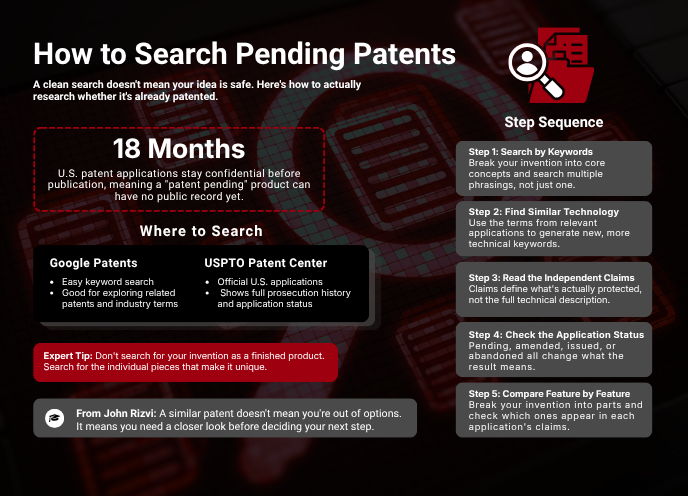
There are many helpful databases that you may use for patent research. Two of the best places to start are Google Patents and USPTO Patent Center. This is where most beginners look for a patent.
There are key elements you must consider during your patent research. One must know them before filing their patent application. This pro guide by John Rizvi can enlighten you about them.
A Protected IP Saves Your Future!
A patent search can help you detect potential problems before you invest more resources into development and patenting of your invention. John Rizvi can give you a clear picture of your situation in the patent world.
How to Find Pending Patents?
Google Patents lets you easily search for a patent using keywords. You can search for a certain invention. You can also review related patents and applications. The feature makes this database especially helpful when you are just getting familiar with the terminology of your industry.
USPTO Patent Center is the go-to database to research applications within the USA. You can find information on patent applications and documents associated with applications. This will allow you to study the prosecution history of a certain application.
Start Your Research With Keywords
The simplest method of doing a pending patent search is by using keywords.
You should split your invention into concepts like:
- Portable cooling device
- Insulated container
- Battery temperature control
- Temperature control of liquid
Conduct multiple searches of random phrases. Do not be stuck with a singular phrase.
Look for Similar Technology
Insufficient to find an application that your product resembles. You should find an application that describes a similar technology to your product.
Your patent searching will get a little more technical. After you find the first relevant patent or application, you can go into the terminology used in the application. Look at the technical terms used in the description and claims.
Those terms will serve as a new set of keywords for further searching.
- Look at the Independent Claims
- Finding a similar application is only the first step.
- Check independent claims.
Independent claims stand alone and describe a unique combination of elements or steps. The description may consist of hundreds of pages of technical information, while the claims point out what the applicant seeks protection for.
Expert Tip
“You should not look for your invention only in its final version as a product. You should look for the pieces that make your invention unique.”

Kevin Noonan
Trademark Attorney
Check the Status of the Application
The next step after you find a relevant application is to see its status.
Applications can have different statuses. Your application can be pending. It can have an office action, be amended, issued, or abandoned.
The current status can change the significance of what you find. An abandoned application should not simply be ignored. Its published technical disclosure can still be relevant to your research. It may also help you discover other related applications or prior art.
Look at the prosecution history when the application appears particularly relevant to your invention.
Feature-by-Feature Comparison of Your Invention
Draw a feature-by-feature comparison.
Dissect your invention into constituent parts. Check to see if each part is present in the claims of any of the related patent applications.
Suppose your invention has five features. A, B, C, D and E. One application may be about A, B and C. Another application may deal with A, D and E. Yet another one may relate to all of them but, in its claims, does not combine those in the same manner.
This sort of comparison provides much more information than simply counting the number of patents “similar” to yours. Exact wording of claims and the way their elements combine matters.
Your Idea Can Stand Higher!
A similar patent does not mean that there is no chance to protect your invention. Consult John Rizvi about your idea to get professional advice.
Conclusion
Pending patents are a crucial component of patent research. They show you if a particular idea is already taken. This will help you to identify already published applications. You may find similar technologies through this process. It can even assist you in learning how others define their related inventions. Such thorough research can help you to make better decisions in terms of your originality.