
Progress happens through innovation. Year after year, there are inventions made that help address challenges differently. There is always one and the same question that comes up during the process of development: what is patentable under U.S. law?
Key Takeaways
Patents play an important role for inventors. They guarantee the exclusive right to use the product or service for which the certificate was received during the established period. Having patent protection increases value and creates additional opportunities.
To assess patent applications in the United States, specific criteria set forth by the United States Patent and Trademark Office are used. It will help determine if your invention should be patented ahead of time.
Have you invented something original?
Now wondering whether it is patentable or not? Get in touch with John Rizvi for a patent analysis now and have your invention patented!
Determining the Patentable Meaning
Patentable meaning is defined as an invention which conforms to the standards outlined in accordance with USPTO regulations. Not every idea is patentable. There are specific conditions which need to be fulfilled before being recognized for a patent.
It is assumed that every original idea can be patented. This assumption causes a lot of misconceptions. Patents are provided for inventions and not for ideas. In addition, the invention needs to fulfil certain conditions.
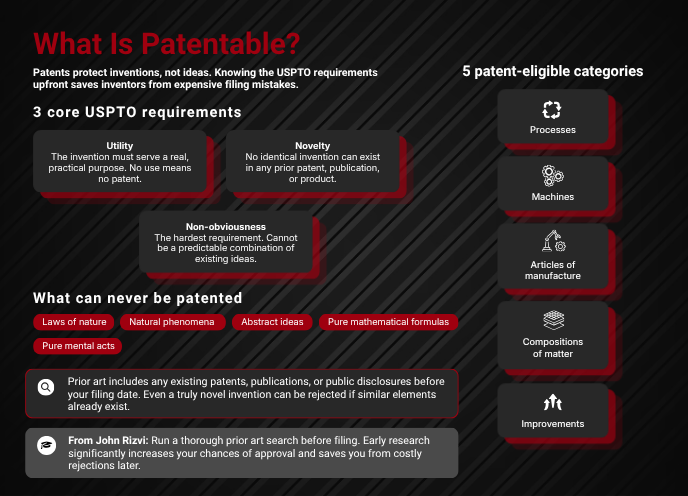
Patentable inventions may consist of machines, manufacturing processes, compositions of matter and improvements on already existing inventions. Moreover, they should fulfil essential requirements of patents.
What Are The Eligible Subject Matters As Per USPTO Standards?
There are many different types of patent-eligible subject matters as per USPTO standards.
| Patent Category | Example |
| Processes | Manufacturing methods or software processes |
| Machines | Engines or medical devices or robotics |
| Articles of Manufacture | Tools or consumer products or equipment |
| Compositions of Matter | Chemical formulas or medicines or materials |
| Improvements | New improvements to existing inventions |
A new medical device would be eligible for patenting. In addition, a unique manufacturing method would also fall under patentable inventions. Any chemical compound used for an intended purpose would also be patentable.
The invention must belong to any of these categories before the USPTO considers the rest of the requirements.
The USPTO Requirements for Patentability
Patentability requirements are the basis of any patent application process.
Utility
The invention should be useful. It should perform a function and offer a practical use. One cannot apply for a patent for any invention that has no purpose or application in real life.
Novelty
The invention should be novel. There should be no identical invention that exists in any patent documents, publication, or commercial product. The USPTO studies previous inventions to see if there is any similar invention to the one being patented. If such a case arises, then the application would be rejected.
Nonobviousness
The invention should not be obvious.
The nonobvious requirement is the most difficult one to meet by the inventors. This is because the USPTO checks if the invention is a predictable combination of other inventions.
What Cannot Be Patented? Types That You Should Know About
Many types of inventions do not fall within the domain of patents. Even irrespective of the creativity involved.
These include:
- Laws of nature.
- Natural phenomenon.
- Abstract ideas.
- Formulas of mathematics by themselves.
- Pure mental acts.
Scientific principles devoid of any practical application. For instance, naturally occurring minerals do not get patent protection merely on account of their discovery. Similarly, a formula based solely on mathematics cannot be granted patent protection.
But practical uses of scientific discoveries can become patentable inventions only if they meet all criteria necessary for patents.
The Importance of Prior Art
Prior art comprises patents, publications, products, public disclosures, and any other disclosure that exists before the filing date.
Prior art is key to deciding the patentability of the invention. Even the most novel invention can be rejected due to prior references containing similar elements.
Conducting a patent search beforehand is advantageous for inventors.
Expert Tip
“Expert Tip: Conduct an extensive prior art search prior to applying for patenting. Early research increases the chances for approval.”

Michael Carter
Senior Patent Consultant
Business Importance of Patentability
Patentability is important not only from a legal perspective but also from a business one.
Effective patents can:
- Help raise funds
- Foster licenses
- Prevent other firms from entering the market
The importance of patents in terms of business can hardly be understated. Companies usually develop patents in order to improve their position in the market and boost firm value.
Ready to secure your patentable invention?
Contact John Rizvi and create a plan that gives you maximum protection and value. Only one meeting can change the fate of your invention.
Conclusion
Knowing what is patentable will assist an inventor in dealing with the patenting process in a much more informed manner. A patentable invention should be within the scope of subject matter that is patentable. In addition, there are criteria of utility, novelty, and non-obviousness that need to be considered when making sure that one’s invention is patentable.