
One might think that drawings and technical information in a patent application would constitute its main protections. The reality is different. Those details are the context for the patent claims. The difference can be the difference between leaving valuable territory unprotected and securing a broad moat around an innovation. Smartly written claims focus on uniqueness and value.
Key Takeaways
The USPTO requires that claims “particularly point out and distinctly claim the subject matter which the inventor or developers regard as the invention.” Specification in the application is required for all terms used in the claims of the patent. This requirement implies that any terms in the claims are not enforceable if the application does not describe these terms adequately.
Claims require a slightly different approach than one might expect. A drafter should aim to separate those features necessary to the invention from the optional or incidental. For example, if multiple fastening mechanisms would work with the invention, specifying only a screw might result in a competitor using a clip instead.
Someone Might Discover the Loopholes!
You have to protect your idea before they do. John Rizvi helps inventors translate ideas into commercially viable concepts. He uses smart claim drafting to eliminate potential loopholes that competitors might use to create similar products.
What Is a Claim in a Patent?
A claim defines what the applicant wants to protect with the patent. Claims dictate the scope of protection and thus are the foundation for infringement assessment; the USPTO takes the broadest reasonable interpretation of any pending claims during examination.
Let’s go back to the example given above: if the invention could be used with different types of fastening mechanisms, stating that only the screw is used might be too limiting. Because the claim would not cover clips within its limits.
Know the Main Types of Patent Claims
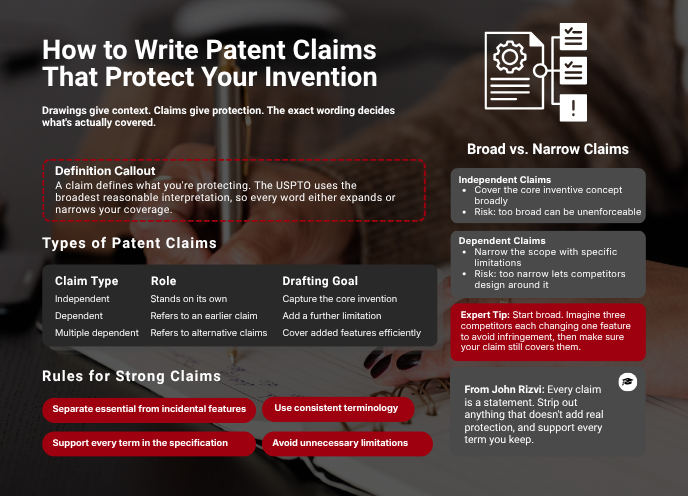
| Claim type | Role | Drafting goal |
| Independent | Stands on its own | Capture the core invention |
| Dependent | Refers to an earlier claim | Add a further limitation |
| Multiple dependent | Refers to alternative earlier claims | Cover added features efficiently |
Federal law allows for independent and dependent claims. The latter two types must refer to an earlier claim. The claim also adds a further limitation and captures all the limitations of its parent claim.
Build the Independent Claim Around Essentials
- Identify the components or steps that comprise the invention.
- Do this as you are defining its boundaries.
- Detail the ways in which they interact with one another.
- Do not add extra limitations for the prototype is using them.
Each additional limitation narrows the scope of the claims and may be deemed to reduce the scope of protection. The specification must enable the claims’ scope as it sufficiently details the invention.
Expert Tip
“Start with a broad claim. Imagine three competing companies modifying one aspect of the invention in order to create an embodiment. That would provide them the commercial benefit they seek without infringing on it.”

Kevin Noonan
Patent Attorney and IP Strategist
Use Dependent Claims as Strategic Backup
Dependent claims allow one to capture narrowing alternatives. They manage this as they establish fallback positions if the broader claim proves unenforceable or too broad. They add limitations such as specifying size and shape.
Each dependent claim must contain all of the limitations of the parent claim while adding one more limitation.
Make Every Term Earn Its Place
Consistency aids understanding. Use the same terms to refer to the same object unless there is a specific reason to do otherwise. The USPTO requires that claim terms and phrases be supported or have a prior basis in the description.
For example, if one uses “a processor,” later claims should clearly refer to the said processor.
The main thing to remember is that every claim is a statement. You need to take out any words that don’t add anything in terms of limiting the scope of the claim.
Stress Test the Claim Before Filing!
Drafting a patent application can shape the commercial future of an inventor for years to come. John Rizvi can help assess the patent landscape and identify the scope of claims.
Conclusion
Patent claims are about the scope of a patent. They tell the reader what it covers. The claims identify the key features and offer alternatives at different levels. Claims make sure that each term is backed up by the specification. When done correctly, they provide the greatest scope of protection while ensuring that enforcement is possible.