

The rise in trademark activity in recent times has been phenomenal—and this is not merely a result of the growing popularity of laws. Businesses today know that securing their brand in its nascent stage could make the difference between growth and expensive lawsuits.
Key Takeaways
However, there is one thing that many business owners still fail to comprehend, which is the range of items that trademarks cover. It is not only essential to protect a company’s name, but it can also include logos, product packaging, colours associated with the brand, and even sounds made by apps during opening.
The bottom line is that if your customer can identify it as something that belongs to your brand, then it can be covered under trade marks. Let us take a look at our easy-to-understand business trademark guide.
Your brand deserves more than guesswork.
At John Rizvi, we help business owners turn ideas into legally protected assets with smart and efficient trademark strategies. Don’t wait until a competitor files first. Secure your identity today.
Trademark Types for Business: The Core Formats
Always remember that you are not just selecting a trademark. You are protecting your identity as a business through several avenues.
Word Marks
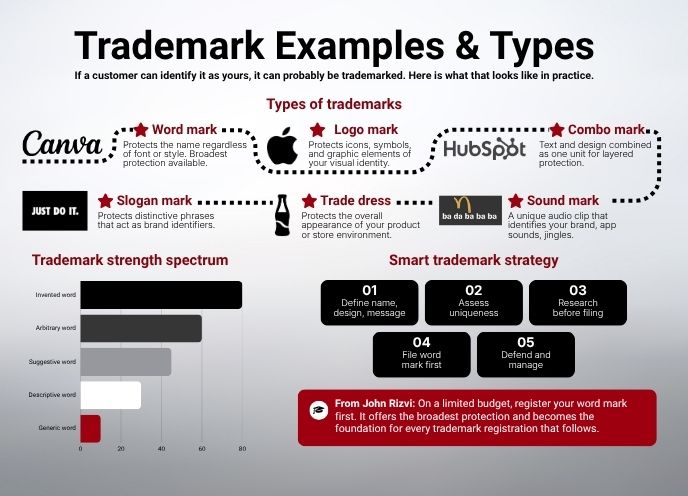
Word marks provide protection for the name alone, irrespective of how it is written. This trademark provides the maximum amount of flexibility since any changes made to typography and logo design won’t jeopardize protection. This trademark offers ownership over the concept rather than the look of your name.
Logo and Combination Marks
Logo marks provide protection against copying of design features such as icons and symbols. A combination mark offers an extra layer of protection by combining text and graphics together to provide a single unit.
These trademarks are great for businesses within creative industries, but they are less flexible than word marks when changes need to be made to your business identity.
Slogan Marks
Slogan marks are a hybrid type of branding and marketing element. When properly crafted, they serve as an excellent way of promoting your business. However, this doesn’t mean that any catchy slogan can act as a trademark – it needs to have a distinctive aspect which would make it a unique business identifier.
Expert Tip
“If there’s one thing that’s important when you’re on a shoestring budget, you shouldn’t try and cover all your bases from day one. The most important step to take first is to register your word mark. This will offer you the broadest protection possible and will act as the cornerstone of all future trademark registrations.”

Daniel Carter
Intellectual Property Attorney & Trademark Strategist
Examples of Non-traditional Marks Beyond the Basics
This is where things start getting more interesting for modern brands and their trademarks. Many businesses nowadays explore various ways of registering their trademarks in a way that goes far beyond visual identity.
Sound trademarks are an example of such trademark innovation. All it takes to trademark your sound is a brief clip of audio that acts as a unique identifier. In case you want to make things even trickier, color trademarks might be just what you need.
Trade Dress: The “Look” of Your Brand
While trademark law concerns the use of words or other identifiers, trade dress concerns the overall look and feel of your product or business environment.
When a customer walks into a business or sees the packaging of a product and immediately recognizes it without any logos being present, you have something called trade dress.
The proof of trade dress is slightly different from trademarks; however, once established, it could be quite difficult for competitors to mimic.
Not All Trademarks Are Created Equal
Not all trademarks are created equally. That leads some business owners to pick terrible names. However, when choosing a trademark, its strength should be your primary focus.
Invented or unusual words will be much easier to protect, while generic or common words will be rejected during registration.
Here is a very simple method to think about trademarks’ strengths:
- The more unique your mark, the stronger your position
- The more obvious it is, the harder it becomes to defend
Choosing a name that “sounds good” isn’t enough. It needs to stand on solid legal ground.
Building a Smart Trademark Strategy Smartly
A successful trademark strategy isn’t left to chance; rather, it’s carefully crafted systematically.
First, define your brand—its name, its design, and its message. Then, assess the uniqueness of each trademark component. Next, ensure you conduct thorough research before taking any steps forward.
Afterwards, focus on filing for protection. Traditionally, firms start with a word mark, followed by logos or slogans upon expansion. Lastly, manage and defend your trademarks to prevent weakening through neglect.
Why let others outpace your brand’s security?
John Rizvi can help you secure the trademarks that matter. Without doubt or missteps, get the advice you need for your brand’s success. Join us now before it gets too late!
Conclusion
Trademark examples are not only a process anymore, but also a necessity in creating a company. With the various types of trademarking options available nowadays, business owners have more opportunities than ever before. This means that they should also take responsibility and make decisions wisely regarding which types of trademarks to choose for their business and when to do trade mark registration.