
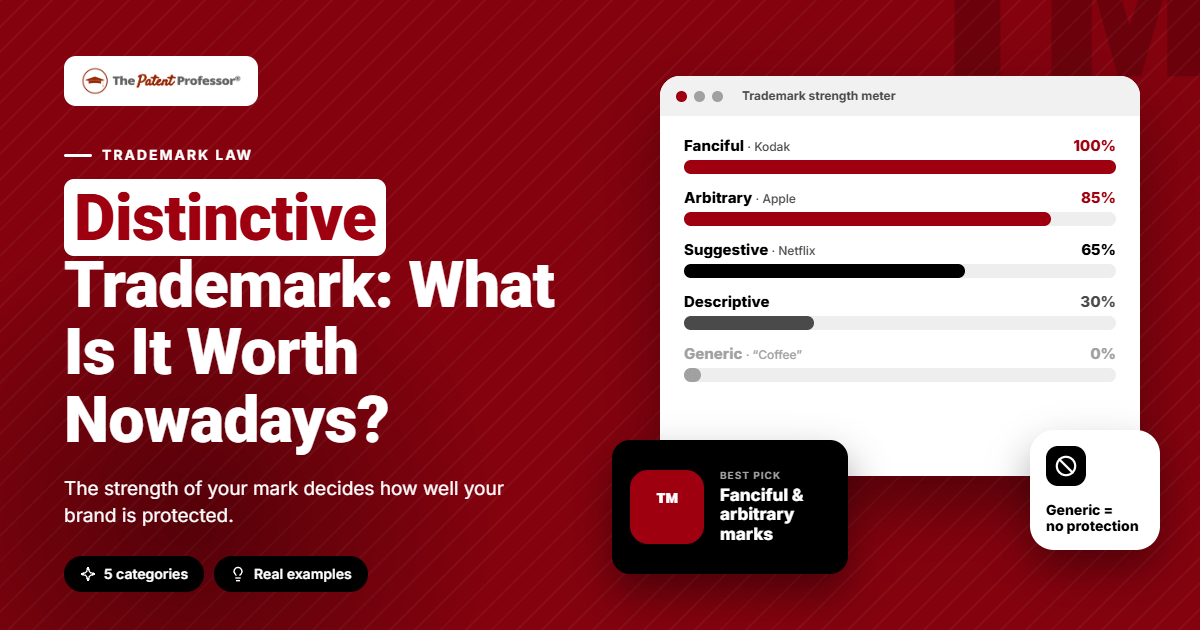
A trademark not only gives a name or logo to a business. It also allows you to identify the source of goods or services. Not all trademarks have equal protection. The degree of protection rests at the distinctiveness of the mark. A distinctive trademark may help distinguish your brand from the competition and get exclusive rights more easily.
Key Takeaways
It is important to know about trademark distinctiveness. More so if one is thinking of picking the right trademark and making investments in the branding process. This knowledge will help you a lot in this area.
Distinctiveness will help people associate a name, sign, or slogan with a certain source. This is the reason why one needs to pick a trademark before any financial resources are spent on branding. Descriptive or confusing trademarks may face legal issues despite their unique appearance.
Ready to safeguard your brand?
John Rizvi will advise on trademark registration and develop an approach for trademarking before you spend a lot of money on your brand.
The Five Categories of Trademark Distinctiveness
These categories will help you understand the concept of trademark distinctiveness better.
Fanciful Trademarks
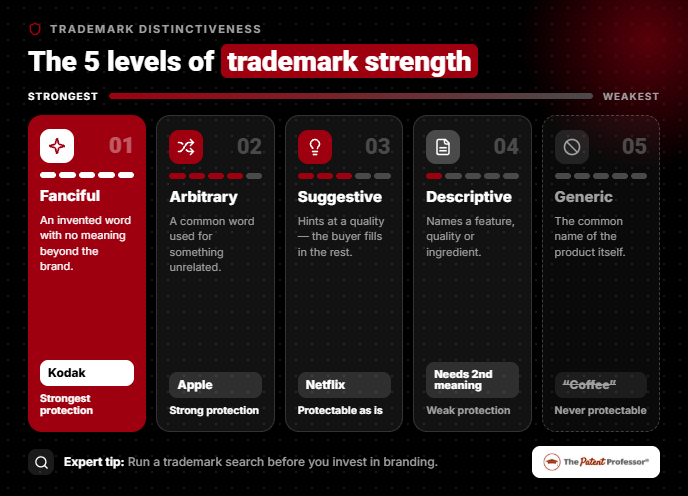
This type includes invented words that exist only to be used as trademarks. Fanciful words have no usual association with the goods or services they refer to. Kodak and Xerox are examples of invented brands. Since these words have been invented solely for marketing purposes, they benefit from robust trademark protections.
Arbitrary Marks
Arbitrary marks use a commonplace word in such a manner that the word does not bear any direct relationship to the goods/services. For example, “Apple” is an ordinary word which does not denote computers and smartphones, but is used as an arbitrary mark for the products.
Suggestive Marks
A suggestive mark refers to the characteristic or quality of the product without saying it explicitly. Here, the consumer needs to exercise some imagination or reasoning in order to connect the mark with the goods/services. Suggestive marks can be trademarked without having to prove acquired distinctiveness, unlike many descriptive marks.
Descriptive Marks
Descriptive marks denote the characteristic and quality or ingredients and functions or features of the goods/services. Descriptive marks have less protection than other types. Under US law, descriptive marks can be trademarked only if the mark gains secondary meaning.
Generic Marks
Generic marks are the names of the broader classes of goods or services and not names of the sources of the goods or services and hence cannot serve as the trademarks of the particular goods or services. In other words, you cannot have a trademark for “shoes” when you sell shoes.
Expert Tip
“Do not rely on trademark search just yet. Never forget that a trademark search has to be performed beforehand to avoid conflicts with existing trademarks.”

Kevin Noonan
Trademark Attorney
Examples of Distinctive Marks
The following are examples of distinctive marks which will help to understand different classes of trademarks better.
Fanciful Mark: Kodak for photographic products.
Arbitrary Mark: Apple for computers and consumer electronic items.
Suggestive Mark: Netflix may be considered a suggestive brand name as it does not describe any particular service and only hints towards the internet-related entertainment service.
Descriptive Mark: Any name that is indicative of the ingredients or qualities of the products in question.
Generic Mark: Coffee for coffee products is a generic mark because it is the name of the product itself.
Classification of the marks depends on the goods or services being used along with the marks.
How to Choose a Distinctive Trademark?
- Find words that do not describe what you sell.
- Look into inventions and combinations of familiar words.
- Think of how the mark would suit your company.
- Conduct a trademark search before adopting your chosen mark.
- There should be no similarities in terms of name and spelling or sound and logo or services and goods.
Get that special trademark!
John Rizvi offers expert services that will help you get that trademark for your invention. Approach us now and let us deal with your work in this regard.
Conclusion
A distinctive trademark can be one of the most important brand assets a company will ever create. It not only differentiates between the source of goods and services but provides the trademark with a strong basis for protection.
Fanciful and arbitrary trademarks are the most inherently distinctive and, in some cases, even suggestive trademarks are sufficiently distinctive. The use of descriptive marks poses difficulties because generic marks can never be trademarked for the goods or services that they identify.
Make sure that the trademark you adopt is distinctive if you are creating a new brand.