
There is always one crucial question in the mind of many inventors. Can you patent an algorithm in 2026? Well, whether you can do so depends on how you use the algorithm. The patent system cannot protect mathematical ideas. An algorithm used in a practical invention solving some technical issue can be patented.
Key Takeaways
Companies use algorithms for software, security, healthcare, finance, and artificial intelligence. This technology generates intellectual property. The patent system can prevent others from making copies of your novel invention. A patent application is more than innovative code. You need to demonstrate the impact of the invention on the advancement of technology.
The laws have been continually developing due to the court rulings and examination guides. One needs to be well-prepared for the process of applying for patents because it helps save time and money. It is better to know what inventions are eligible for patenting before making a product.
Make sure your innovative product is safe!
Contact John Rizvi, who provides practical patent-related legal services. Meet with a knowledgeable patent attorney before applying for a patent.
Why Patent Eligibility Is Important
The patent system gives owners exclusive rights to an invention. Owning a patent may add value to the company. It will help you attract investors or license your technology. The patent system protects against any imitation of your valuable technology.
There are many software programmers who think that all valuable programs are worthy of being patented. This is not how patent law works. Examiners first find out if the invention is something abstract. Then they find out if there is some kind of inventive concept within the application.
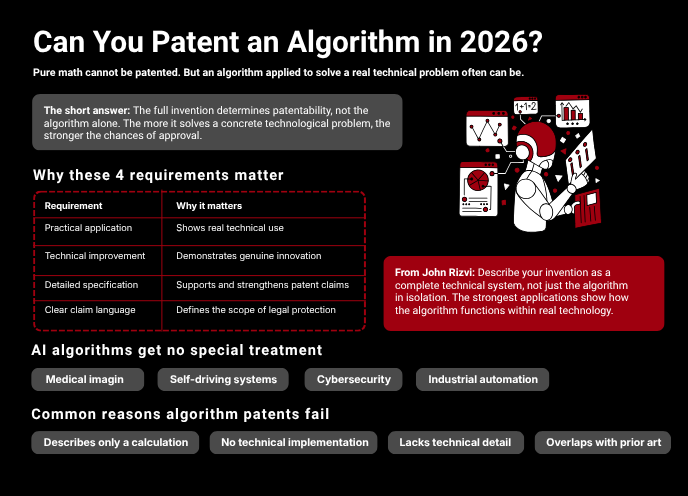
| Requirement | Why It Matters |
| Practical application | Shows real technical use |
| Technical improvement | Demonstrates innovation |
| Detailed specification | Supports patent claims |
| Clear claim language | Defines legal protection |
Can Algorithms Be Patented? The Real Answer Here
The issue of whether algorithms are patentable can be answered positively, but with a caveat. While pure algorithms cannot be patented because of their abstract nature, a system using an algorithm that enhances computer performance, helps with diagnosis or increases production efficiency will most likely be patentable.
The entire invention determines its patentability, not the algorithm itself. Attention is still being paid to the way the algorithm functions within the context of some technology. The more it resolves technological problems, the greater its chances are of getting a patent.
Features That Ensure a Patent for Algorithm Application
- A successful patent for an algorithm describes the technical problem solved by the algorithm and its technical solution.
- It must include all the necessary details in order for another skilled person to reproduce the invention.
- Claims for a patent need to have a description of the improvement.
When people ask, can you patent an algorithm, the key is showing how it works as part of a useful invention that solves a technical problem.
This would ensure that the invention has a distinct advantage over mere abstract ideas. There also need to be multiple types of claims in an application for a patent.
Expert Tip
“Explain your invention as a whole technical system and do not dwell upon the algorithm itself alone. The best inventions are always described in full.”

William Harris
Intellectual Property Lawyer
Common Reasons Why Patents for Algorithm Applications Fail
In many cases, patent applications fail since they describe only business methods or calculations. Claims are rejected by examiners if they do not have a technical implementation.
Another common reason why patents fail is a lack of technical details. Lack of precision weakens the protection provided by patents and increases the ambiguity of the examination process. Disclosure enhances both.
One should not forget about prior art. Publications and inventions from the prior art may include similar technologies. Conducting a patent search beforehand is necessary to find all possible issues. If you are asking, can you patent an algorithm, a thorough prior art search can help determine whether your invention is likely to meet patentability requirements.
Can You Patent an Algorithm in Artificial Intelligence?
Many inventors wonder whether algorithms are patentable when they relate to artificial intelligence. The answer comes under the same legal framework. AI does not get any special treatment in patent law.
A machine learning invention must do more than process mathematically. The invention must make an advancement in technology relating to computing or another technological area. Medical imagery, self-driving cars, cybersecurity, and industrial automation are all areas where examples of patent-eligible inventions can be found.
Inventors must describe the operation of the AI invention as part of a greater system. Applications that only relate to training data or mathematical formulas tend to have trouble getting examined.
So, if you are wondering, can you patent an algorithm, the answer depends on whether it is part of a practical invention that delivers a real technical solution.
Use preventable reasons to secure your invention!
John Rizvi will be able to examine your invention and draft claims according to current requirements for patents. Legal consultation always helps to save time and money.
Conclusion
Can you patent an algorithm? The answer will depend on how the invention uses the technology to solve a technical problem. The patent law protects inventions, not abstract mathematical formulas. Good technical disclosure, well-formulated claims, and proper preparation considerably increase the chance of approval. Knowing these principles, inventors are able to make better patent applications and protect their innovations in 2026.