
How to Patent an Idea for Free
Patenting an idea is the only legal gateway to gain exclusive rights to it. Securing a patent is a complicated and lengthy process; hiring a patent attorney is the best way to proceed. These professionals do not work for free; they charge a lot for their services. It makes you wonder how to patent an idea for free. Good news: there are ways for that.
File a Patent on Your Own
“Pro se” filing or filing a patent on your own is a complex task. It is not impossible, though. Patent applications require legal criteria to be considered. You should have proper knowledge to achieve this.
Have an idea worth protecting?
Get expert insight from John Rizvi and start your patent journey today!
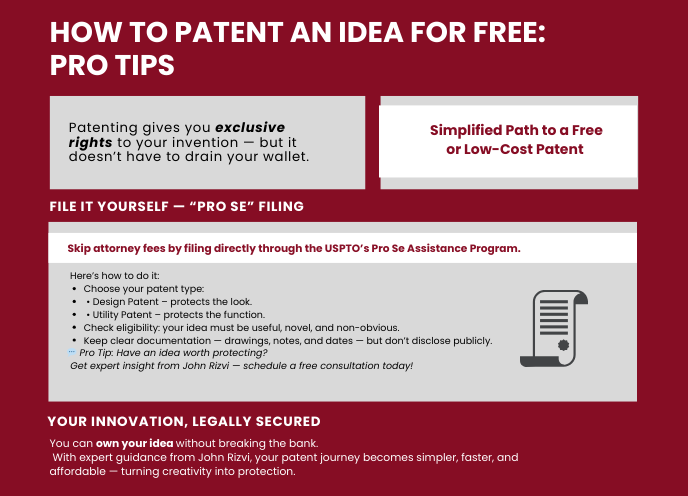
USPTO’s Pro Se Assistance Program is developed to help inventors who work independently with their application process. Follow these steps if you want to file a patent on your own:
1. Select the Right Patent
The USPTO introduces two kinds of patents. You should select the one that suits your best interests. They include:
Design Patent: Design patents are used to protect the non-functional, visual, and aesthetic aspects of your invention. This patent offers no protection for the functional part of your invention.
Utility Patent: Utility patents are used to protect the functionality and operability of an invention. Those aspects include what the specific methods are and how they work. Your invention must have a beneficial use to get a utility patent.
2. Determine Patent Eligibility
Your idea must be eligible to earn patent protection. How so? Your IP idea should be:
- Useful. A practical application gets accepted soon enough.
- Non-obvious. It should not be a simple variation of existing IPs.
- Novel. New and unused before.
Your invention is highly likely to be patented if it checks these points.
3. A Patent Search
Conducting a patent search saves your time and money. Do not invest right away. Conduct a complete patent search through online databases like the USPTO database.
4. Document, Not Disclose
Detailed records of your invention evidence your originality. Drawing, photographs, descriptions, and key notes of your work prove that you conceived the idea. Add dates and valuable information to solidify it further.
Documenting is not disclosing! Keep your records only to yourself to avoid your patents being compromised.
Q: How can I patent an idea for free?
A: File it yourself through the USPTO, use free inventor resources, and seek pro bono legal help if you qualify.
5. Prepare Your Patent Application
Visit a relevant and legal website that allows you to submit patent applications. Sign up there and begin the process.
The order for design patents:
- Design application transmittal form
- Fee transmittal form
- Application data sheet
- Specification
- Drawings or photographs
- The inventor’s oath or declaration
The order for utility patents:
- Application transmittal form
- Fee transmittal form
- Application data sheet
- Specification
- Drawings
- Executed oath or declaration
Draft in the recommended order of each patent.
Steps to Patent Your Idea Yourself
6. Pay the Fee
Fees for filing a patent application must be paid. The fee amount depends on your entity status and patent type. The general fee costs range from $220 to $320. Check the fee schedule and pay it accordingly.
Q: How to file a patent for free?
A: Use the USPTO’s Pro Se Assistance Program and apply as a micro-entity to minimize or waive fees.
7. File the Application
Review your patent application. Check if something is amiss. All the necessary information and documents must be attached. Show it to someone knowledgeable enough to offer a good piece of advice. Finally, submit your application.
8. Wait for the Examination
The online platform where you submitted your application will examine it. The process can take up to months. You might be requested for revisions or clarifications to your application.
The patent examiner will send an Office Action. It will have details of issues in your application. Address these concerns on time and make changes per demand.
Q: How much to patent an idea?
A: Usually between $220 and $320 for small or micro-entity filings, plus possible extra costs later.
9. Receive Your Patent
Once your application is in the right shape and good to go, you will get a Notice of Allowance. This shows that you are eligible for a patent and your applica
tion is approved. Pay the issuance fee (and possibly a publication fee). This fee completes the process. Your patent will be issued in time.
The Patent Pro Bono Program
USPTO launched the Patent Pro Bono Program in 2011 to offer free legal assistance to inventors who meet the criteria for patent filing. The program connects worthy inventors with registered patent attorneys or agents. These professionals do not need to be paid as they are often volunteers.
Make no mistake: the inventor will still pay the USPTO fees for the process. This program is available in every U.S. state. This makes patent filing in the U.S. quite easy. Quite a small price to pay for the protection of your invention, no? Yes!
Feel free to look into the Patent Pro Bono Program. It is a simple and legal way in case you are still wondering how to patent an idea for free.
FAQ
Expert Tip
“Before filing your patent application, make sure you conduct a complete patent search and clearly define what makes your invention different from anything that already exists, because this step determines whether your idea truly qualifies as patentable.”

Gene Quinn
Patent Attorney and President and CEO of IPWatchdog, Inc.