
You might feel that your groundbreaking ideas are useless when you do not know how to implement them. Lack of information about the patent selling process can result in such a feeling of disappointment. This means you have to learn about how to sell a patent. We are here to aid you in that endeavour.
It’s not simply a matter of finding a buyer. It’s about proving the value of your patent, showing that there’s demand, and making your invention look like a business waiting to happen. When you know how to sell a patent, you are not just an inventor but also a dealer with leverage.
A considerable process minimizes risk and gives you the best possible shot at making a handsome profit. Every step of the process brings you closer to a smooth and profitable sale.
Key Takeaways
How to Patent an Idea and Sell it?
A curious question, indeed. Great ideas precede successful businesses. We at John Rizvi are well aware of that and are the right people to guide you through this complex process of selling a patent.
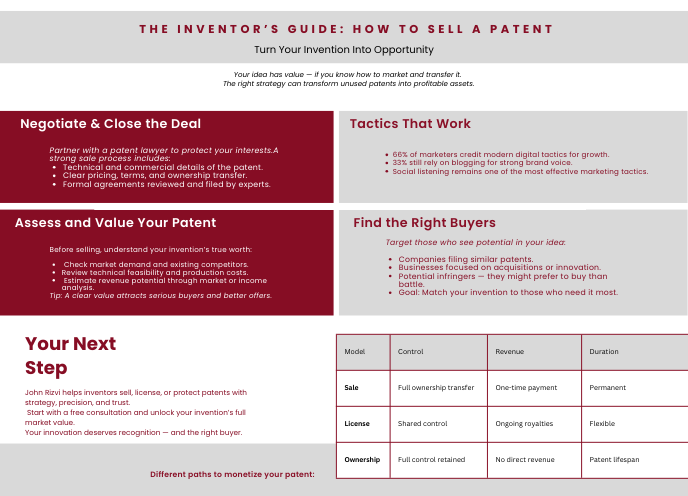
1. Assess the Patent Potential and Market Practicality
Should I assess the market potential before I sell my patent? Hell yes, you should! You should measure the commercial value of your ideas and inventions.
- Conduct a proper analysis to find out if similar products already exist. If they do, you might face legal issues.
- Analyze the target audience and market demand to confirm there is a great user base for your talented product.
- Evaluate the production cost and technical feasibility of the invention to ensure it is affordable in the market.
2. A Quantitative Analysis to Estimate the Market Value
You should be aware of the quantitative information around before your patented invention reaches the market. It is more than about having a fair price; it is about building a catchy case for potential buyers.
- A market-based approach for recent sales to benchmark a reasonable price.
- Consider expenses for research and development, maintenance fees, and patent filing to establish a baseline.
- An income-based analysis can help you project the future revenue that you can generate. Consider the market potential and patent’s remaining lifespan.
Bring your patent to life as a real-world financial success with the help of seasoned experts.
Talk to trusted experts who can guide you through every step of your patent valuation and negotiation processes.
3. A Qualitative Analysis for Added Evaluation
A quantitative analysis helps you realize the subjective factors that impact your patented invention’s worth beyond just numbers. This step shows how you can appeal to have a strong negotiating position.
- Assess the market practicality of your ideas. They should fit a specific niche or solve a critical issue.
- Examine licensing agreements and the patent life to understand the limitations of IP and the full scope of it.
- Analyze the present and future competition to figure out the competitive edge and influence on the buyer.
4. Identify Potential Buyers
The step is quite self-explanatory. Identify the right audience and just hit the mark! How? Use a proactive approach that greatly boosts the chances of a sale. A licensing deal or a sum payment. All are welcome.
- Look for companies that have a history with relevant patents or have recently filed a similar patent.
- Search for businesses with inorganic growth. It shows they proritize acquiring new tech and ideas rather than developing them.
- Identify market players who could be infringing on your patent rights. They might buy your invention to avoid legal action.
5. A Patent Lawyer for Negotiation Deal
Work with a patent lawyer to negotiate the deal that promotes a fair and profitable sale. This is where you turn to John Rizvi. Handling complex legal cases is well within our capacity; the rising success rate should grab your attention.
- A strong negotiation deal should contain the patent’s technical details, its usefulness, and how it is beneficial to potential buyers.
- Have a list of ideal buyers. Send an attractive “teaser” document to pique their interest.
- Handle negotiations well. Your invention can see bright days ahead if this goes well.
6. Draft the Sale Agreement and Close the Deal
Drafting a powerful sale agreement gives you a legal shield to protect your interests. This is how you can facilitate a seamless transfer of ownership. Patent lawyers at John Rizvi can develop fascinating deals to safeguard your intellectual property.
- Finalize a formal agreement for the patent transfer.
- Outline the sale terms clearly. Include payment schedules and any current IP rights.
- Partner up with a lawyer and file the ownership transfer. Execute the sale of your patent application.
Expert Tip
“Documentation is key to having strong negotiating leverage. Buyers want to fund your idea based on evidence, not just your idea itself.”

Thomas
Ex-USPTO Director & IP Lawyer
Patent Sales vs Licensing vs Ownership: Ways to Monetize Patents
There are multiple ways for patent monetizing. Licensing the patent and selling the patent are common ones. You can have it under your ownership as well. You can pick an option that suits your interests best.
| Aspect | Patent Sales | Patent Licensing | Patent Ownership |
| Legal control | Full transfer of ownership to the buyer | Licensor retains ownership and allows usage rights to licensee | The owner has the right to exclude others from making, using, offering for sale, selling, or importing the invention in question |
| Scope of rights | Buyer receives all patent rights | Rights may be limited as to time, place, or field of use | Full and unrestricted rights within patent scope |
| Duration | Permanent transfer | Duration depends on agreement terms, which can range from temporary to permanent | Lasts for the life of the patent ( 20 years from filing on average) |
| Revenue model | One-time lump sum payment | Ongoing upfront fees, royalties, or milestone payments | No direct revenue unless licensing or selling |
| Risk Distribution | Risk transfers to the buyer | Risk shared between licensee and licensor | The owner bears commercialization risks |
| Relationship Type | One-time transaction and done deal | Often involves a permanent (or at least long-term) partnership | Independent control, no ongoing relationships needed |
Your invention should not be subject to doubt and conjecture.
Arm yourself with expert knowledge and a clear strategy to ensure you negotiate the best possible deal for your patent. Safeguard your interests while maximizing your patent’s earning capacity.
Conclusion
Knowing how to sell a patent gives you a solid chance in the market. Find trusted patents for sale that can make your dream come true with your invention. John Rizvi has the right expertise to maximize the true potential and financial gains of your patents. We look forward to being your aide!