
The rate of development of software technologies is fast. Intellectual property law follows suit. The top technology companies in 2026 have made patent applications on technologies related to generative AI and digital assistants. It shows where the future lies. Some software patents examples may serve as good indicators for this purpose.
Key Takeaways
Studying software patent case studies goes beyond being an intellectual pursuit. Patents are, indeed, innovation maps.
John Rizvi leads businessmen and women through the complicated link between patents and software in an evolving digital world. Studying software patent application cases will provide you with a competitive advantage against other firms.
You may have an innovative solution!
A solution to every problem is stored in your software. Software patents examples give you that competitive edge. Approach John Rizvi to find out how.
9 Recent Software Patents Examples You Should Monitor for Your Work
1. Glean
Enterprise search with Generative AI
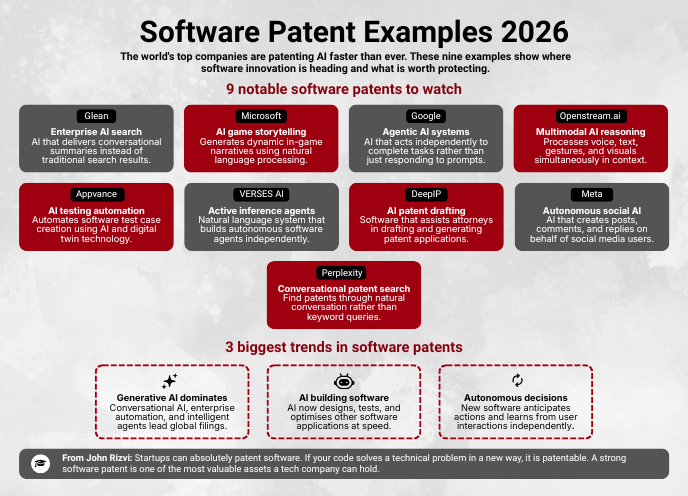
The enterprise-focused startup Glean applied for a software patent related to search summary solutions using artificial intelligence. The software uses artificial intelligence algorithms and large language models to give conversational summaries rather than search results.
This software patent represents one of the most popular enterprise software patents in this sector.
2. Microsoft
AI for Video Games Storytelling.
Microsoft obtained a patent on the software capable of generating stories in games through natural language processing.
3. Google
Agentic Artificial Intelligence Systems.
As per the recent stats, Google holds the maximum number of patents in AI especially those related to agentic AI systems capable of doing work on their own.
As is evident from the above patents, AI assistants have become very crucial for businesses as compared to reactive systems.
4. Openstream.ai
Multimodal AI Reasoning.
Openstream.ai was granted a patent that pertains to AI systems that can process voice, text, gestures, facial expressions, and visual data in parallel.
The above example shows that modern-day software patents emphasize contextual reasoning rather than separate features.
5. Appvance
AI Software Testing Automation.
Appvance holds a patent that enables software developers to automate test case scenarios through AI and digital twin technologies.
The patent shows how modern software testing is undergoing changes through automation.
6. VERSES AI
Active Inference Agents.
VERSES AI holds a patent regarding a natural language system that creates intelligent software agents via an active inference algorithm.
It illustrates how the AI is creating autonomous enterprise software through active inference.
7. DeepIP
AI Patent Drafting.
DeepIP invented software that can help patent attorneys draft summaries of ideas, innovate and make patents on its own.
What is remarkable about the software in the present era is that it facilitates the process of patent drafting.
8. Meta
Autonomous Social Media AI.
The latest discussion regarding Meta patents centres around the development of AI technology. They can facilitate users’ creation of posts and comments and replies in social media.
This case study demonstrates the transition of AI from supporting functionality to emulating digital identities.
9. Perplexity
AI Patent Research.
The breakthrough company called Perplexity has offered an AI solution. That will help people find patents based on conversational searches rather than keyword searches.
This solution holds great promise for reinventing the process of searching for patents.
Expert Tip
“One of the most common misunderstandings about startups is that they are unable to patent software. Software is perfectly patentable if it solves some technical problems.”

Robert Plotkin
Software Patent Attorney
The Biggest Trends in Software Patents
The first notable trend is generative AI. According to WIPO statistics, patents related to AI software dominate the current global scene across many application fields. The major concentration is on conversational AI and enterprise automation along with cybersecurity and intelligent agents and predictive AI.
The second trend is centred around AI’s role in developing software applications. The employment of AI software for the purpose of designing and testing with optimizing and even patenting other software applications results in exponential acceleration in the development process.
There is an increasing trend toward automation software. The newer AI software applications anticipate actions and make decisions independently as well as learn from their interactions with users.
Software innovation is much more than coding.
A smart patenting strategy may be instrumental in securing funding, protecting your idea from rivals, and ultimately boosting business value.
Conclusion
Modern software patents examples illustrate a technological environment that features the prominence of AI, automation, personalization, and intelligence. John Rizvi has stepped up to shape a quality software patent for your idea. Reach out to him and get your work done now!